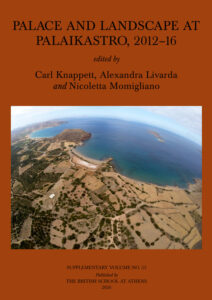
Carl Knappett, Alexandra Livarda & Nicoletta Momigliano (επιμέλεια)London2026
This volume presents the results of a five-year survey and excavation project at Palaikastro (east Crete). By shining a light on the site’s immediate landscape, the project has revealed long-term agropastoral subsistence strategies in the area, from the Neolithic to the Late Bronze Age.
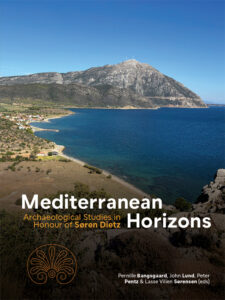
Pernille Bangsgaard, John Lund, Peter Pentz & Lasse Vilien Sørensen (επιμέλεια)Leiden2026
The Mediterranean has always been a crossroads of cultures, ideas, and histories. From the Stone Age to the first millennium BC, this vibrant region shaped—and was shaped by—the movements of people, the exchange of goods, and the rise of complex societies. Mediterranean Horizons celebrates the career of Søren Dietz, a pioneering archaeologist and founder of The Danish Institute in Athens whose work has illuminated these connections across time and space.
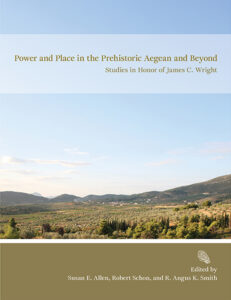
Susan E. Allen, Robert Schon & R. Angus K. Smith (επιμέλεια)Pensylvania2025
This volume celebrates the contributions and impact of our mentor, colleague, and friend, James C. Wright, on the field of Aegean Bronze archaeology in recognition of his retirement from Bryn Mawr College. The title and thematic orientation reflect his scholarly attention to power inequalities in the past, particularly as manifested through social access to architectural spaces and landscapes.
The Lion Gate is an icon, a piece of art more than 3300 years old, representing the glory of Mycenaean Greece. Preserved in situ, it has passed through time and circumstance, witnessing its own civilisation fail and many others flourishing since. Often considered as an emblem for the royal house of Mycenae, it is the only surviving piece of large-scale sculpture of the Greek Bronze Age.
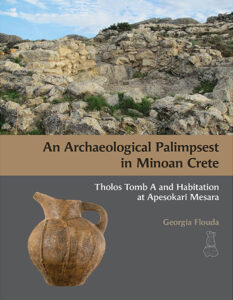
This publication presents the archaeological evidence from two associated Minoan sites situated at Apesokari in the Mesara Plain of South-Central Crete, Tholos Tomb A and the neighboring free-standing domestic complex on Vigla Hill.
The date of the destruction of the palace at Knossos on Crete has been one of the key problems of Aegean prehistory since the palace was excavated at the beginning of the 20th century. The excavator Arthur Evans argued for an LM II date as he presumed that the inscribed tablets found in the palace destruction layers must have been written by the people who had produced the large and richly adorned Palace Style jars which he dated to the LM II period.
Anna Lucia D’Agata & Peter Pavúk (επιμέλεια)Rome 2023
It was during a conference dinner in Rome, a few years ago, that we started talking about a collective volume in honour of Penelope Mountjoy that now we can hold in our hands. Being a scholar of an indisputable quality, which transcends time and space, this volume does not intend to celebrate a special anniversary, but rather our honoree’s extraordinary and enduring contribution to Aegean archaeology.
Το παρόν βιβλίο αναδεικνύει τις εικόνες ως μεθοδολογικά σύνθετα ερευνητικά εργαλεία μελέτης της προϊστορικής αρχιτεκτονικής στην Ελλάδα. Εξετάζονται 200 και πλέον τελικές δημοσιεύσεις ανασκαφών προϊστορικών αρχαιολογικών θέσεων από την πρώτη ανασκαφή του Heinrich Schliemann στις Μυκήνες το 1876 μέχρι σήμερα.
Emmett L. Bennett Jr., José L. Melena, Dimitri Nakassis, Jean-Pierre Olivier & Thomas G. Palaima (eds)Columbus2025
In 1939, on the first day of excavation on a hill in western Messenia, Carl W. Blegen uncovered a Mycenaean palace that he called The Palace of Nestor. Its archives contained clay tablets inscribed in the so-called Linear B script, a syllabary employed to record the Greek language.
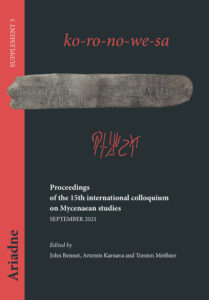
John Bennet, Artemis Karnava & Torsten Meißner (επιμέλεια)Ρέθυμνο2024
As editors and organisers, we were gratified to note a good number of early- and mid-career scholars among those contributing to this volume, and even more early-career scholars and students had expressed an interest in attending the meeting itself, leaving the editors in no doubt that interest in Mycenaean, and indeed Aegean studies more widely, is unbroken and continues to attract the intellectual attention of rising academics in a large number of disciplines.
Το έργο αυτό αποτελεί συστηματική μελέτη των απαρχών της οίκησης του Ελλαδικού Χώρου, από τις πρωιμότερες διαθέσιμες μαρτυρίες την Μεσολιθική έως και την Πρώιμη Εποχή του Χαλκού (9η - 3η χιλιετία π.Χ.), συνεκτιμώντας ανάλογα δεδομένα από την ευρύτερη Ανατολική Μεσόγειο (κυρίως 14η χιλιετία π.Χ. κ.ε.), Εγγύς Ανατολή, Μεσοποταμία, Ανατολία, Πόντος - Κασπία, Αίγυπτος - Αφρική.
The site of Phylakopi on Melos occupies a special place in the prehistory of the Aegean Bronze Age. The first work there by the British School at Athens in 1896–99 (there were two further campaigns, in 1911 and 1974–77) was memorably described by Carl Blegen as ‘the first really serious effort to understand stratification, the first really good excavation in Greece’. The Field Director, Duncan Mackenzie, kept detailed day-to-day records of the work, later applying methods developed on Melos to the excavation of Knossos.
Reinhard Jung και Ελευθερία Καρδαμάκη (επιμέλεια)Vienna2022
The Late Bronze Age Mycenaean palaces in southern and central Greece stood at the head of the earliest state system on the European continent. The authors, all leading scholars in Bronze Age research and often engaged in excavating the palace sites themselves, focus in their contributions on the most recent progress in pottery studies, in order to arrive at precise relative chronological dates of the destruction events. The investigated archaeological sites range from Crete in the south to the Peloponnese with the palaces of Pylos, Ayios Vasileios, Mycenae and Tiryns and further north to central Greece with the palace of Thebes, while contemporary sites on Cyprus and in Syria are taken into consideration as well.
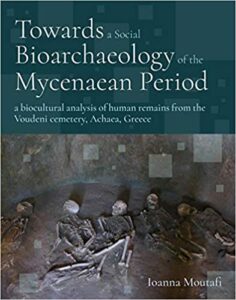
This book investigates the complex relationship between funerary treatment and wider social dynamics through a contextual analysis of human skeletal remains and associated mortuary data from Voudeni, an important Mycenaean (1400-1050 BC) chamber tomb cemetery in Achaea, Greece.
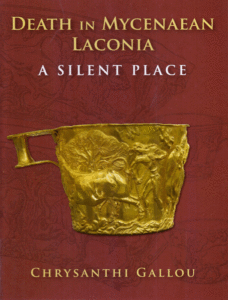
A Silent Place: Death in Mycenaean Lakonia is the first book-length systematic study of the Late Bronze Age (LBA) burial tradition in south-eastern Peloponnese, Greece, and the first to comprehensively present and discuss all Mycenaean tombs and funerary contexts excavated and/or simply reported in the region from the 19th century to present day.